The problem
Real estate investors live and die by one number: the After Repair Value, or ARV. It is what a house should sell for once it is fixed up. Most tools hand back one automated price that treats a gutted fixer-upper and a renovated home alike. Investors end up redoing the work by hand.
What I built
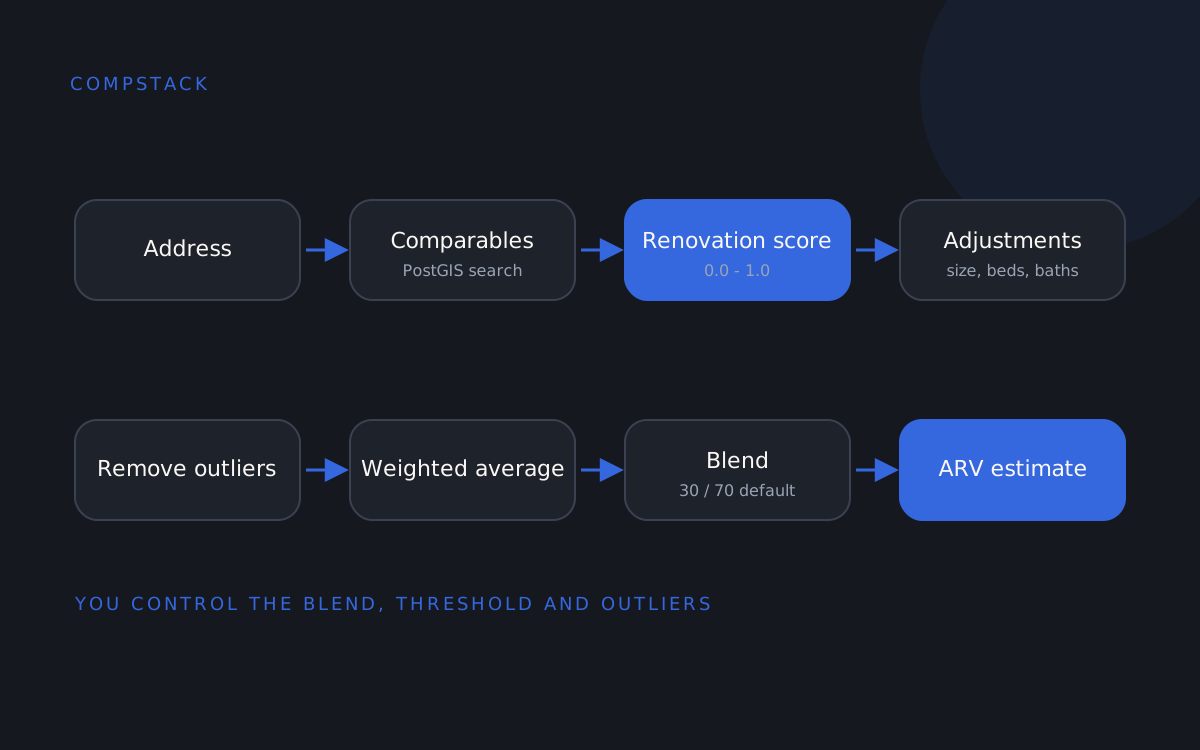
CompStack is a full product that I designed, built and run myself. You enter an address. It pulls a baseline property value and the property facts from a licensed data provider, then finds comparable sales nearby using spatial queries in PostGIS.
My own models do the rest. A renovation detector scores each comparable on how likely it is to be a renovated home, so the estimate leans on the sales that actually look like your finished project. An adjustment engine then corrects each comparable for differences in size, bedrooms, bathrooms, age and lot. Outliers are removed, the rest are weighted, and the result is blended with the baseline value. The default blend is 30% model and 70% baseline.
The investor stays in control. The blend weight, the renovation threshold, outlier removal and the minimum number of comparables are all adjustable, so the estimate can be tuned to how a given market behaves.
The backend is a FastAPI service with PostgreSQL. The models live in their own Python package so they can be tested and improved without touching the API. The web app is SvelteKit. Sign-in uses Firebase, and billing and plans come from the shared Meeks Labs billing service rather than a one-off checkout.
Stack
- FastAPI on Python 3.13, with Alembic migrations
- PostgreSQL with PostGIS for spatial comparable search
- A separate machine learning package for the renovation detector and adjustment engine
- SvelteKit front end
- Firebase Auth, Stripe through the Meeks Labs billing service
Outcome
CompStack turns an address into an ARV estimate that shows its work: which comparables it used, how each was adjusted, and how much weight the model got against the baseline. It has accounts and plans, and it is the valuation engine behind my iOS app, Veris.
It is also a good example of what I do for clients: take a judgment call that a person makes by hand, and build a system that makes it faster and easier to check.