The problem
In equipment service and operations, the answer to almost any repair question is somewhere in a manual. The trouble is the size. A technician on a job can face thousands of pages of PDFs across many models, and finding the right paragraph costs time with the equipment down and the customer waiting.
Some of that material is also sensitive. Sending it to a public AI service was not an option for every use.
What I built
I built a document question-and-answer system for technicians, in two parts.
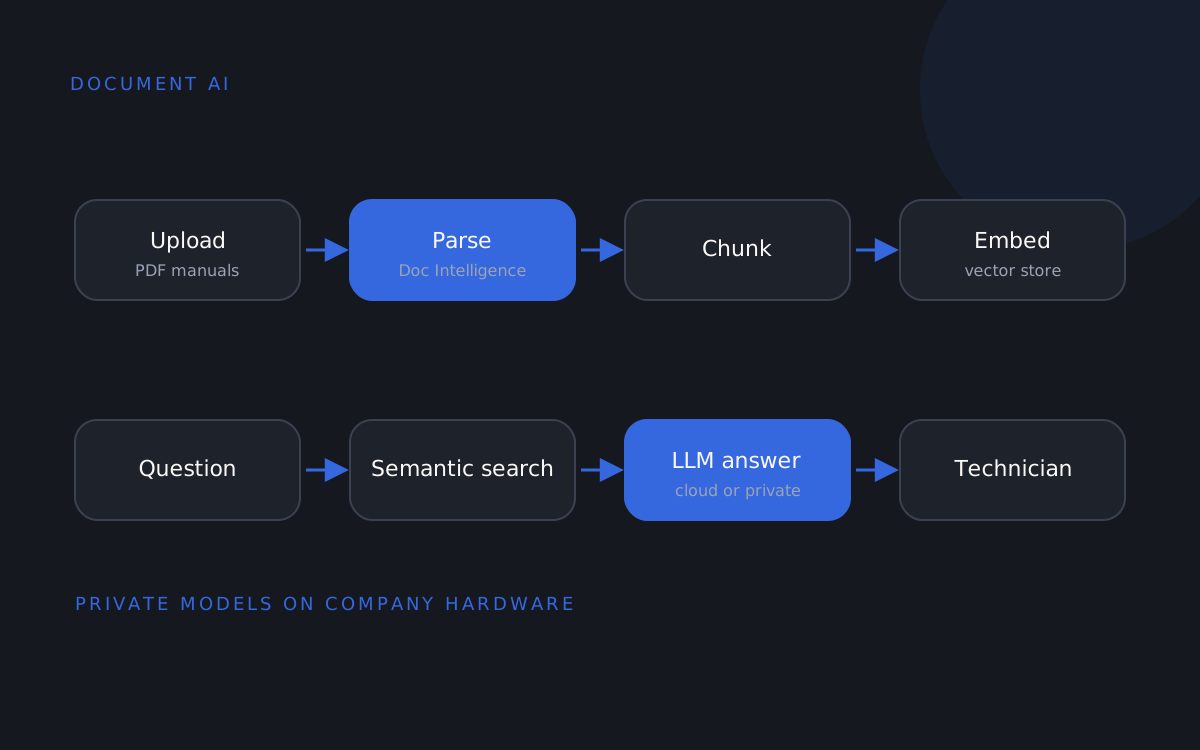
The document pipeline. A user uploads a manual. A background worker parses it with Azure Document Intelligence, then cuts the text into sensible chunks. Each chunk is turned into an embedding and stored for semantic search. This work runs in the background, so uploading a large manual never freezes the app.
The chat. A technician asks a question in everyday words. The system searches by meaning, not just keywords, pulls the most relevant passages, and gives them to a language model on Azure OpenAI to write a clear answer grounded in the manuals.
Private models. For data that should never leave the company, I researched, deployed and ran open models on company-owned hardware. The same chat works against them, so the privacy decision is a setting, not a rewrite.
Stack
- FastAPI for the API
- Celery workers for parsing and embedding
- Azure Document Intelligence for reading PDFs
- Azure OpenAI for answers
- Embeddings and semantic search over the manual library
- Open models served on local hardware
Outcome
Technicians get answers from thousands of pages of manuals without searching them by hand. Teams can choose cloud models or fully private ones depending on the sensitivity of the material, and sensitive data stays inside the building when it needs to.